Watchdogs vs Guard Dogs: The Honest Difference
What separates a watchdog from a guard dog, what German Shepherds actually are, why protection training is wrong for a family pet, the legal reality, and how to train sensible alerting without a barking problem.


Short answer: a watchdog tells you, a guard dog acts — and your German Shepherd should be the first one
A watchdog notices something and alerts you. That is instinct, it needs no training, and almost every German Shepherd does it by default. A guard dog is trained to confront or engage, which is specialist work with real legal and safety consequences. For a family pet the useful goal is a dog who barks once, then looks at you — alert, controllable, and no liability to anyone.
Somebody always says it at the park. “Bet nobody breaks into your place.” And there is a small, slightly guilty part of most German Shepherd owners that enjoys hearing it — right up until the same dog barks at a delivery driver for four solid minutes and you find yourself apologising through a closed door.
The confusion behind both moments is the same. People use “watchdog” and “guard dog” as if they mean the same thing, and they do not. One is a natural behaviour to be shaped and managed. The other is a trained specialism that most owners neither need nor want, and which carries consequences that rarely get mentioned alongside the reassurance.
This guide sets out the real difference, what German Shepherds actually are, why “protection training” for a family pet is a bad idea, how to get sensible alerting without a barking problem, the legal reality of owning a dog who bites, and what genuinely improves home security.
German Shepherd Place does not publish protection, bite-work or guard-dog training instruction. This article explains the difference between the terms and how to live with a naturally alert breed. If you have a genuine professional security need, that is a job for licensed specialists, not a blog.
The Difference in One Table
| Watchdog | Guard dog | |
|---|---|---|
| What they do | Notice and alert — usually by barking | Trained to confront, hold or engage a person |
| Training needed | None. It is instinct | Extensive, specialist, ongoing |
| Typical breeds | Almost any alert dog — including small ones | A small number of dogs with specific temperament and training |
| Risk to household | Low — the main issue is noise | Significant. A trained bite is a serious event |
| Legal exposure | Normal dog ownership | High. You are responsible for any bite, trained or not |
| Right for a family pet? | ✅ Yes — with management | ❌ Almost never |
There is a third category worth naming: the personal protection dog, professionally trained and handled, used in security work. Those dogs are selected for very specific temperament, trained for years, handled by people with the appropriate licensing, and insured accordingly. They are not family pets that also do a job at weekends.
Almost everyone who says they want a guard dog actually wants a watchdog with good manners — a dog who notices, tells them, and then settles. That is entirely achievable and requires no protection training whatsoever.
What German Shepherds Actually Are
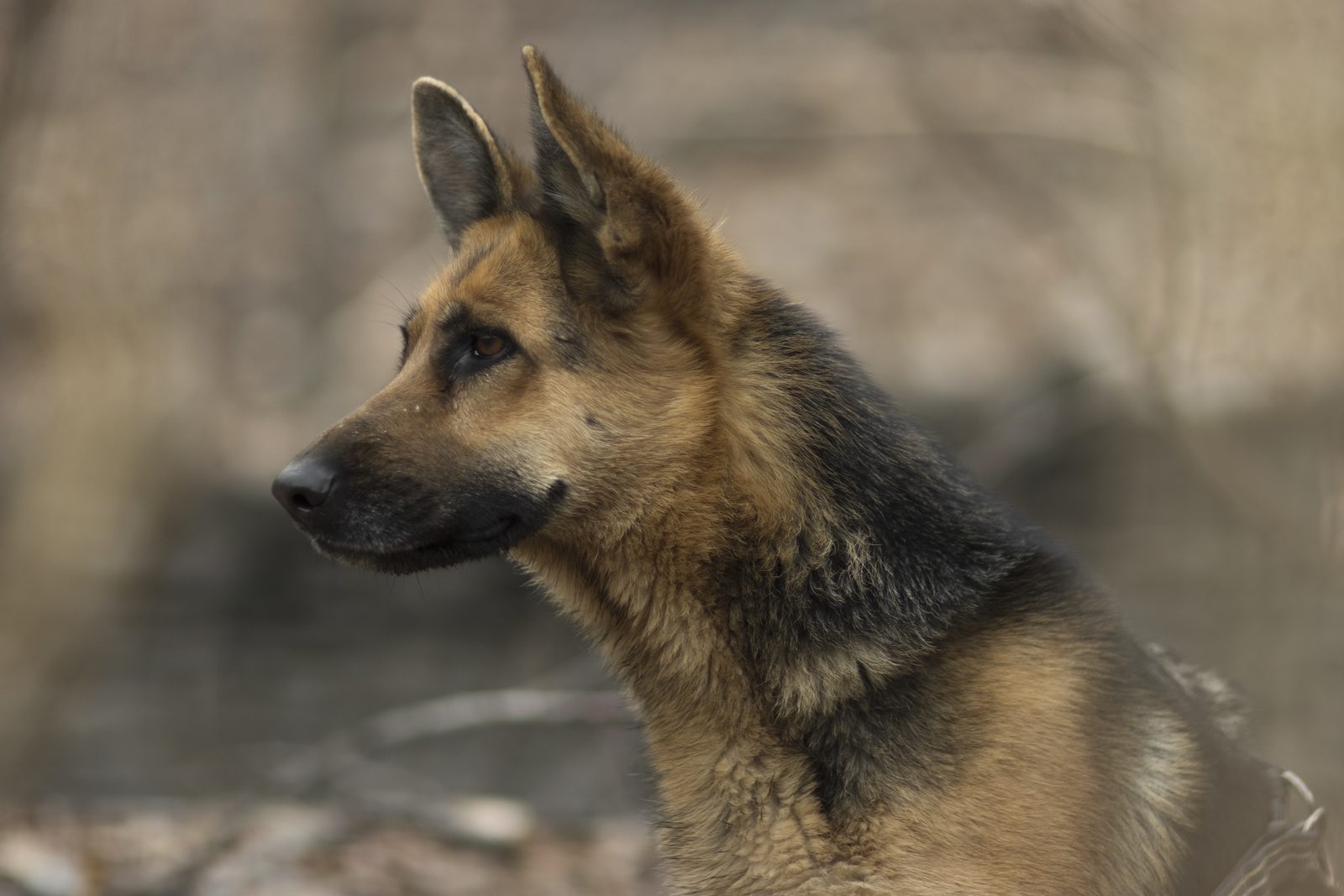
The breed was developed to herd and to patrol boundaries — a living fence keeping sheep out of crops. That job selected for a dog who notices everything, monitors territory, and thinks independently. It did not select for a dog who confronts people.
The breed standard describes a confident, steady dog who is aloof with strangers but not hostile. Aloof means indifferent — not interested in greeting everyone, and equally not interested in threatening anyone. A German Shepherd who is fearful, or who reacts aggressively to ordinary people, is not displaying breed character; that is a temperament problem, usually from poor breeding, missed socialisation, or fear.
The police and military association came later and is trained work, done by carefully selected dogs with professional handlers. Your dog has the same ancestors as those dogs and none of the training — which is exactly as it should be. Our breed history traces how that reputation came about.
Why the Deterrent Effect Is Real (and Mostly Free)
Here is the genuinely useful part: you get almost all of the security benefit from an ordinary, well-mannered dog.
Studies of convicted burglars and crime-prevention advice from police forces consistently point in the same direction — the presence of a dog is a meaningful deterrent, and the deterrent is the barking and the uncertainty, not the dog’s fighting ability. An opportunist choosing between two houses will take the quiet one. They do not stop to assess whether the noise behind the door comes from a trained protection dog or a very cross terrier.
Which means the security value of a German Shepherd is delivered by simply existing, barking when someone approaches, and being visible. None of that requires — or is improved by — teaching a dog to bite.
Why Protection Training Is a Bad Idea for a Pet
- A dog who can tell friend from intruder
- Protection available “only if needed”
- An off switch that works under stress
- No change to family life
- A safer household
- Something you can train at a weekend course
- Dogs judge by behaviour and context, not intent — postmen and joggers get misread
- Rehearsed biting makes biting more likely, not more selective
- Under real stress, training is far less reliable than owners expect
- Insurance, tenancy and travel all become complicated
- You are liable for every bite, in any circumstance
- Badly delivered “protection” courses create dangerous, conflicted dogs
The most serious problem is the one people never anticipate: a dog trained to bite has practised biting. Rehearsed behaviours become more likely in ambiguous situations — and a 38 kg dog making a judgement call about the neighbour reaching over the fence is a risk with no upside for an ordinary household.
Anyone offering to make your pet “protection trained” quickly, cheaply or via a short course. At best it is theatre; at worst it uses fear, agitation or aggression-provoking methods that leave a dog anxious and unpredictable — and you legally responsible for the result. If you have a genuine professional security requirement, that is a regulated industry with licensed handlers, not a weekend upgrade for the family dog.
The Legal Reality
Laws vary considerably by country, but a few principles turn up almost everywhere, and they are worth knowing before anyone jokes about their dog “handling” an intruder.
- You are responsible for your dog’s behaviour — including on your own property in many jurisdictions, and including towards people who are lawfully there such as postal workers and meter readers.
- “He was protecting me” is rarely a defence. Courts generally look at whether a dog was dangerously out of control, not at the owner’s interpretation of motive.
- Consequences can be severe — compensation, control orders, restrictions, and in serious cases destruction orders and criminal liability.
- Insurance may not cover a trained bite. Many pet policies exclude dogs trained for protection work, and some exclude liability if the dog has a bite history.
- Tenancies and travel get harder. Landlords, insurers, boarding kennels and some countries treat protection-trained dogs differently.
Check your own country’s rules — and if you keep a dog in a garden that a delivery driver enters, a “beware of the dog” sign is not the protection people assume it is. Signage requirements and their legal effect differ, and a sign can sometimes be read as an admission that you knew the dog was a risk.
Training Sensible Alerting
This is the achievable, genuinely useful goal: a dog who barks a couple of times, then comes to you and settles. Here is how to build it.
Thank the alert — do not punish it
When your dog barks at the door, say “thank you” in a calm voice and go and look. Genuinely look. Then carry on.
Why it works: the dog’s job is to tell you. Punishing that creates conflict and often produces a more anxious, more reactive barker rather than a quiet one.
Teach “go to bed” as the doorbell routine
Practise with a knock or bell at low intensity: sound, then guide to the mat, then pay. Build up until the sound itself sends them to the mat.
Why it works: “quiet” tells a dog what not to do. A mat gives them a job — far easier for a working breed to follow under excitement.
Pay the pause, not just the silence
The moment your dog stops barking to take a breath or look at you, mark it and reward. You are building “bark, then check in”.
Why it works: most owners only engage once the barking is at full volume, so the quiet version never gets paid.
Manage the trigger where you can
Move the bed away from the front window, use frosted film on glass facing a path, add background sound near the door.
Why it works: a dog who rehearses barking fifty times a day gets very good at barking. Removing the rehearsals does half the work for you.
Introduce the regulars properly
Where it is safe and welcome, let your postal worker or regular delivery driver toss a treat. Many are happy to; some emphatically are not, so ask first.
Why it works: it converts a daily conflict into a daily good thing — and the dog still alerts, just without the four-minute tirade.
When Alerting Becomes a Barking Problem
Alerting is normal. Barking for twenty minutes at a leaf is not — and the difference usually comes down to arousal, boredom or anxiety rather than “guarding”.
Look at the whole picture: is the dog getting enough physical and mental work? Is the barking worse when they are alone (which points to separation distress rather than territory)? Is the household stressed? A German Shepherd with an unspent brain will absolutely invent a security job and perform it enthusiastically all day. Our guides to why dogs bark and enrichment cover the fixes.
Growling or lunging at visitors, guarding doorways or furniture, or any bite — even one that did not break skin — is a job for a certified, reward-based behaviourist, and worth a vet check first because pain is a common hidden trigger. These problems get harder to resolve the longer they are rehearsed, and they are not solved by “showing the dog who is boss”.
What Actually Improves Home Security
If security is the real goal, it is worth being honest about where the dog sits in the list.
| Measure | Effect | Notes |
|---|---|---|
| Good locks and doors | ★★★★★ | The single biggest factor. Most break-ins are opportunistic |
| Lighting and visibility | ★★★★☆ | Motion lights, trimmed hedges, no cover to work behind |
| An alarm and cameras | ★★★★☆ | Visible deterrent plus evidence if something happens |
| A dog who barks | ★★★★☆ | Genuine deterrent — and it works whether the dog is 5 kg or 40 kg |
| Neighbours who notice | ★★★☆☆ | Underrated, free, and improves everything else |
| A protection-trained dog | ⚠️ | Adds little deterrent over a normal dog, and adds significant risk and liability |
The practical summary: lock the door, light the path, and let the dog be a dog. Your German Shepherd will do the alerting part enthusiastically and for free.
Kit That Helps
We recommend product types and the features that matter rather than sponsored placements, and we link to live Amazon results instead of quoting prices that go stale. As an Amazon Associate we may earn from qualifying purchases — at no extra cost to you.
A raised bed or mat, plus a gate
The most effective anti-barking equipment is not a collar — it is a defined resting place away from the front door and something that stops your dog rehearsing at the window. A mat gives the doorbell routine somewhere to end, and a gate removes the trigger while you train it.
- Gives an alerting dog a job that ends, instead of one that escalates
- Portable, so the routine works in other rooms and other houses
- A gate stops fifty rehearsals a day at the front window
- No aversive equipment involved
Good to know: pair it with the “go to bed” steps above and reward generously for the first few weeks. The mat only works if going to it has been made worthwhile.
| Item | Why it helps | Find it |
|---|---|---|
| Frosted window film | Stops the dog watching and barking at the path | See options → |
| Tall baby gate | Keeps the dog away from the front door during deliveries | See options → |
| White noise machine | Masks corridor and street sounds that trigger alerts | See options → |
| Treat pouch | Lets you pay the quiet within a second | See options → |
| Motion-sensor lights | Does more for security than any dog | See options → |
7 Mistakes (and the Fix for Each)
❌ 1. Encouraging aggression “for protection”
Winding a dog up at the window or letting them chase the postman teaches exactly the behaviour that ends in a bite report.
✅ Fix: reward calm noticing. A dog who alerts and settles is more useful and infinitely safer.❌ 2. Buying protection training for a family pet
It creates risk without adding meaningful deterrent, and it complicates insurance, tenancy and travel.
✅ Fix: ordinary obedience plus good door manners. Your dog is already a deterrent.❌ 3. Punishing the bark
Suppressing the warning does not remove the underlying feeling — and a dog who stops warning may go straight to the next step.
✅ Fix: thank the alert, then redirect to a mat. Manage the trigger so it happens less often.❌ 4. Using an anti-bark collar
Spray, vibration and shock collars address the noise, not the cause, and often increase anxiety in a breed that is already sensitive.
✅ Fix: management plus training, and a behaviourist if the barking is distress-based.❌ 5. Leaving a “guard dog” alone in the garden
Boredom, fence-running and frustration build reactive behaviour, and gardens are where most delivery-driver incidents happen.
✅ Fix: dogs live indoors with the family; secure the gate; do not leave a dog loose where visitors must enter.❌ 6. Assuming the dog knows friend from foe
Dogs read behaviour and context, not intent. Nervous visitors and running children can look far more suspicious than a calm intruder.
✅ Fix: manage introductions, use gates, and never rely on a dog’s judgement about people.❌ 7. Ignoring the first growl at a visitor
It gets described as protectiveness right up until it becomes a bite.
✅ Fix: treat it as information. Vet check for pain, then a certified behaviourist — early.The best security dog most people will ever own is a friendly one who barks twice at the door and then goes back to sleep. Everything beyond that adds risk to your household, not safety.
Frequently Asked Questions
What is the difference between a watchdog and a guard dog?
A watchdog notices something and alerts you — that is instinct and needs no training. A guard dog is specifically trained to confront or engage a person. Almost every German Shepherd is naturally a watchdog; very few should ever be guard dogs.
Are German Shepherds natural guard dogs?
No. They are natural watchdogs — alert, territorial and vocal. The protection work the breed is famous for is trained, done by carefully selected dogs with professional handlers. A well-bred pet German Shepherd should be confident and aloof with strangers, not confrontational.
Will my German Shepherd protect me if something happens?
Nobody can promise that, and it is an unreliable thing to plan around. Some dogs place themselves between their owner and a perceived threat; others do not. What you can count on is the barking and the deterrent effect — which is where almost all of the practical security value sits anyway.
Should I get protection training for my dog?
For a family pet, no. It adds meaningful risk and liability, complicates insurance and housing, and adds little deterrent beyond what an ordinary barking dog already provides. Genuine security needs are met by licensed professionals with purpose-selected dogs.
Am I legally responsible if my dog bites an intruder?
In many jurisdictions, yes — including on your own property, and certainly towards anyone lawfully present such as a delivery driver. Laws vary, so check your own country’s, but do not assume that “he was protecting the house” is a defence.
How do I stop my dog barking at the door without losing the alert?
Thank the first bark and go and look, then teach “go to bed” as the doorbell routine and reward the pause after barking. Manage the triggers — bed away from the window, frosted film, background sound. The aim is bark-then-settle, not silence.
✅ Your Watchdog Checklist
- Goal set: bark, check in, settle — not silence, not confrontation
- First bark thanked, never punished
- “Go to bed” trained as the doorbell routine
- The pause after barking rewarded, every time
- Bed moved away from the front door and window
- Frosted film or a gate to stop daily rehearsals
- Regular delivery people introduced positively where welcome
- Dog never left loose in a garden visitors must enter
- No anti-bark collars, no agitation “for protection”
- No protection or bite training for a family pet
- Growling at visitors → vet check, then a certified behaviourist
- Real security handled by locks, lights and an alarm
The Bottom Line
A watchdog tells you something is happening. A guard dog is trained to do something about it. Your German Shepherd is built to be the first one, and that is genuinely the version you want living with your family.
Let them notice things. Thank them for it, teach them where to go afterwards, and manage the windows and doorways so they are not practising all day. You will end up with a dog who deters the opportunist, greets your friends politely, and has never once put you in front of a solicitor — which is what everyone actually wanted from “a good guard dog” in the first place.
- Why do dogs bark? — the seven types and how to reduce each
- Solving behaviour problems — the eight most common issues
- Introducing the German Shepherd — temperament, honestly
- The history of the breed — where the reputation came from
Recommended German Shepherd gear for this guide
Training treat pouch with clip
Best for: Hands-free training sessions
- Magnetic close
- Clip-on belt
Affiliate link — we may earn a commission, at no cost to you.
Low-calorie training treats
Best for: High-frequency reward training
- Soft, easy to break
- Quick consumption
Affiliate link — we may earn a commission, at no cost to you.
Long training line (30ft)
Best for: Recall practice in safe open areas
- Builds recall
- Lightweight options
Affiliate link — we may earn a commission, at no cost to you.

Keep reading
More in Training →
Shock Collars for Large Dogs: What the Evidence Says and Safer Alternatives
What controlled studies actually found about electronic collars, why they appear to work, the specific risks, where the…
Why Do Dogs Bark? The 7 Types of Barking and How to Reduce Each
Seven distinct types of barking and the different fix each one needs, how to identify which you have,…

Treating Separation Anxiety in Dogs: A Step by Step Plan
How to tell separation anxiety from boredom, why a camera is essential, finding your dog's threshold, the graduated…