The Dog Whisperer Method: What It Is and What Modern Behaviour Science Says
What the Cesar Millan method actually consists of, the parts that genuinely work, why dominance and pack leader theory was retracted by the scientist who popularised it, the techniques behaviourists advise against, and what to do instead.

Short answer: he was right about exercise and calmness, and wrong about the pack
Cesar Millan popularised three genuinely useful ideas — dogs need far more exercise than owners give them, your own emotional state matters, and structure helps. But the theory underneath it, that dogs are trying to become “pack leader” and need to be dominated, was built on wolf research the original scientist himself later retracted. The confrontational techniques that follow from it are the part every major veterinary behaviour body now advises against.
If you got a dog any time after about 2005, there is a good chance your first mental model of dog training came from a television programme — a man in a black shirt walking into a chaotic house, standing very still, making a short “tssst” noise, and leaving forty-two minutes later with a transformed animal and a tearful family.
The Dog Whisperer was enormously influential, and it is still one of the most common reasons owners arrive at a behaviourist saying “I’ve tried being the pack leader and it isn’t working.” That makes it worth taking seriously rather than dismissing — because a lot of what Cesar Millan said was sensible, and the parts that were not have specific, well-documented problems.
This article separates the two. What the method actually consists of, what it genuinely got right, where the evidence disagrees and why, what the profession recommends now, and — most usefully — what to do instead if you have a German Shepherd and the pack leader approach has stopped working.
This is not a takedown of a person. Cesar Millan worked with dogs that other people had written off, and he made millions of owners think about exercise and their own behaviour. The disagreement here is about a specific theory of why dogs do what they do — and that theory has moved on a long way since the programme first aired.
What the Method Actually Is
Stripped of the television framing, the Dog Whisperer approach rests on four pillars.
Exercise, discipline, affection — in that order
The best-known slogan, and the most defensible part. The claim is that owners deliver these in exactly the wrong order — affection first, and lots of it, with almost no physical exercise and no consistent structure. Reverse the order and many problems shrink.
Calm-assertive energy
The idea that dogs read and mirror your emotional state, so an anxious or frustrated handler produces an anxious or frustrated dog. Handlers are coached to slow down, breathe, stop talking and stop tightening the lead.
Being the pack leader
The theoretical core: dogs live in hierarchies, and behaviour problems arise when the dog believes they occupy the top position. The remedy is to establish yourself above them — controlling space, going through doors first, eating first, not allowing furniture, and correcting attempts to “challenge” you.
Correction and “rules, boundaries, limitations”
Unwanted behaviour is interrupted — with a sound, a touch to the neck or flank, a lead correction, or in more extreme cases by physically restraining the dog on their side until they stop resisting. The dog is then expected to offer a calmer state, which is accepted rather than rewarded.
Pillars one and two are about the dog’s needs and your behaviour. Pillars three and four are about a theory of dog social structure. You can keep the first two entirely, and this article argues you should — the disagreement is with the second two.
What It Gets Genuinely Right
It would be dishonest to skip this part. Several of the observations are correct, and are still the first thing a good behaviourist checks.
🏃 Under-exercised dogs are a huge share of “behaviour problems”
Completely true, and especially for working breeds. A great many reactive, destructive and restless dogs are simply dogs with nowhere to put their energy. Fixing the exercise fixes a surprising amount.
😌 Your emotional state genuinely transmits
Dogs read human body language and tension acutely, and there is real evidence that owner stress correlates with dog stress. Tight lead, held breath, sharp voice — the dog notices all of it.
📐 Predictable structure reduces anxiety
Clear, consistent rules do help dogs. Where the theory goes wrong is in why — it is not about rank, it is about predictability. But the practical advice to be consistent is sound.
🗣️ Owners talk far too much
Repeating a cue eight times, chattering nervously, filling silence with noise. The instruction to be quiet and still is good handling advice regardless of what school you belong to.
There is a fifth thing worth crediting: he took on dogs that had been given up on, at a time when the standard advice for a seriously aggressive dog was often euthanasia. Whatever one thinks of the methods, the willingness to try was not nothing.
The Pack Leader Problem
Here is where it comes apart, and the history is unusually clean — because the scientist whose work created the idea spent the second half of his career trying to correct it.
Where “alpha” came from
The dominance hierarchy model comes from studies of captive wolves — unrelated adults from different families, put together in an enclosure. Under those conditions they fought, and a rigid rank order emerged. That work, from the 1940s, gave us the word “alpha”.
Where it fell apart
When researchers finally observed wolves in the wild for long periods, they found something quite different. A wild wolf pack is a family — a breeding pair and their offspring of various ages. The “alphas” are simply the parents. There is no ladder to climb and no ongoing contest for the top job, any more than there is in a human household with children.
David Mech, the biologist whose 1970 book The Wolf did more than anything else to spread the alpha concept, has since spent years publicly asking people to stop using it — and has asked his own publisher to stop reprinting the outdated book. He has described the term as “outmoded” and the captive-wolf model as misleading.
The pack-leader model requires you to accept two things: that captive wolves tell you how wild wolves behave, and that wolves tell you how domestic dogs behave. The first was disproved by field research. The second ignores roughly 15,000 years of domestication that specifically selected dogs for cooperating with humans rather than competing with them.
What free-living dogs actually do
Studies of free-ranging and village dogs — the majority of dogs on the planet — do not find tightly structured wolf-style packs at all. They find loose, fluid associations, scavenging rather than cooperative hunting, and relationships that shift with context and resources. Dogs are not small wolves running a hierarchy, and your Shepherd is not applying for your job.
The dog on your sofa is not staging a coup. They are on the sofa because it is warm and soft and nobody has taught them anything different.
The Techniques That Concern Behaviourists
If the underlying theory is wrong, the techniques built on it inherit the problem. Four in particular draw consistent professional criticism.
| Technique | The stated purpose | The concern |
|---|---|---|
| Alpha roll — pinning a dog on their side or back until they stop struggling | Establishing rank; producing “submission” | Wolves are not rolled by others; they offer it voluntarily. Pinning a frightened dog risks a serious bite and teaches them that hands near the neck are dangerous |
| Flooding — exposing a fearful dog to the full-strength trigger until they stop reacting | Showing the dog there is nothing to fear | A dog who stops reacting may have shut down, not recovered. Fear frequently returns worse, and trust in the handler drops |
| Lead corrections and “touch” pokes | Interrupting an unwanted state | Punishment tells a dog what not to do without teaching what to do instead, and can attach pain to whatever the dog is looking at — often another dog |
| Prong and electronic collars | Control of a strong dog | Associated with stress signalling and, in the case of e-collars, worse welfare outcomes than reward-based alternatives in controlled studies |
The common thread is suppression. All four can stop a behaviour quickly. None of them changes how the dog feels about the thing that caused it — and with fear-based and aggression-related behaviour, how the dog feels is the entire problem.
A growl is a warning, and warnings are useful. Punish growling often enough and many dogs stop growling — but they have not stopped feeling threatened. You have removed the early-warning system and are left with a dog who now appears to bite without warning. This is one of the most common histories behind serious bite incidents, and it is worth knowing before you correct a growl.
What the Evidence Says
This is no longer a matter of competing opinions between trainers. There is a reasonably consistent research picture, and the professional bodies have taken clear positions.
Confrontation and aggression
A widely cited survey study from the University of Pennsylvania asked owners which techniques they had used and what the dog did in response. Confrontational methods — hitting, alpha rolling, staring down, growling at the dog, physically forcing an item from the mouth — produced an aggressive response from a substantial proportion of dogs. Reward-based methods produced aggression at a fraction of the rate.
Welfare and learning
Controlled studies comparing aversive and reward-based training have repeatedly found more stress signalling in aversively trained dogs — lip licking, yawning, lowered body posture, raised cortisol — both during training and afterwards in unrelated settings. Several found no advantage in obedience outcomes to offset it. Put simply: it does not work better, and it costs the dog more.
Where the profession has landed
The American Veterinary Society of Animal Behavior has published position statements rejecting dominance theory as a basis for training and advising against punishment-based methods. Comparable positions have come from veterinary and behaviour organisations across Europe and Australasia. The standard now taught is LIMA — least intrusive, minimally aversive — which requires you to exhaust the gentler options before escalating.
Much of this research is owner-reported and correlational — it cannot fully separate “confrontation causes aggression” from “already-aggressive dogs attract confrontation”. That caveat is real. But the direction is consistent across many studies and designs, and no body of evidence has emerged showing an advantage for confrontational methods.
Why It Looks Like It Works on Television
This is the question that matters to most owners, because the transformations on screen are genuinely striking. Four things explain them.
- Suppression is fast; learning is slow. A dog who has been startled or restrained will stop what they were doing within seconds. It looks like resolution. It is more often a pause.
- Editing. Days of filming become forty minutes. You see the moment it worked, not the six attempts before, and not the follow-up months later.
- The handler changed, not just the dog. A skilled, physically calm professional taking the lead from an anxious owner changes the dog’s behaviour immediately — and that effect is real, and has nothing to do with rank.
- Shutdown reads as calm on camera. A dog who has gone still, flat and quiet after being overwhelmed looks, to an untrained eye, exactly like a dog who has relaxed. Behaviourists watching the same footage often see the opposite.
It is worth noting that the programme itself carried an on-screen warning telling viewers not to try the techniques at home. That warning was there for a reason, and it is the single most under-quoted part of the whole phenomenon.
Why This Matters More With a German Shepherd
Every dog deserves better than an outdated model, but a few features of this breed raise the stakes.
- Size and bite force. A confrontation that a terrier loses, a 38 kg Shepherd may not. The cost of getting it wrong is measured in hospital visits.
- They are sensitive to their handler. This breed was selected to work in close partnership with one person. Harsh handling from that person lands harder than it does on a more independent breed.
- They generalise fast. A Shepherd who is corrected while looking at another dog is entirely capable of concluding that other dogs predict pain. That is how leash reactivity is manufactured.
- Legal exposure. A large, dark, upright-eared dog involved in an incident attracts a level of scrutiny that a spaniel does not, regardless of who started it.
What to Do Instead
The replacement is not “let the dog do whatever they want”. Modern reward-based training is at least as structured as the pack-leader approach — the structure just does a different job.
Ask what the behaviour is achieving
Every behaviour works for the dog somehow — it gets attention, distance, food, or relief from something frightening. Identify the function before you try to change anything.
Why it works: “he’s being dominant” gives you nothing to act on. “He barks at the window because barking makes the postman leave” gives you three options immediately.
Change the picture before you change the dog
Frost the window, move the bed, use a barrier, walk at a quieter hour. Management is not cheating — it stops the behaviour being rehearsed while you train.
Why it works: every repetition makes a behaviour stronger. Preventing repetitions is half the work done before training starts.
Teach the thing you want instead
You cannot reinforce an absence. Pick a specific alternative — go to the mat, look at me, walk beside — and pay it generously until it is the default.
Why it works: the dog needs somewhere to put the energy. Give them a job that is incompatible with the problem and the problem has nowhere to live.
For fear and reactivity, work under threshold
Find the distance at which your dog can see the trigger and still eat, take a breath and look away. Work there — pairing the trigger with something good — and close the gap slowly over weeks.
Why it works: this changes the emotion rather than the display. It is slower than a correction and it is the only thing that reliably holds up under pressure.
Keep the exercise and structure
Two long sniffy walks, real mental work, a predictable routine and clear house rules. This is the part of the original advice that survives entirely intact.
Why it works: an under-stimulated German Shepherd will generate their own job, and you will not like the one they pick.
Training treat pouch, 10 m long line and a clicker
Reward-based training fails far more often through logistics than through principle. If the food is in a sandwich bag in your pocket, you are two seconds late every single time — and two seconds is the difference between marking the behaviour and marking whatever came next. A magnetic-close pouch on your hip, a long line so recall practice is never a gamble, and a clicker for precision cover almost everything you need for the first year.
- Puts the reward within a second of the behaviour — the whole game
- Long line gives real-world recall practice with no risk
- Clicker marks the exact moment, which speeds learning noticeably
- Biothane does not absorb water, mud or hold burrs like rope
Good to know: a long line is not a lead — attach it to a well-fitted harness, never a collar, because a Shepherd hitting the end of 10 m at speed generates a great deal of force. And let it drag rather than holding it taut.
| Item | What it does | What to look for | Find it |
|---|---|---|---|
| Treat pouch | Puts the reward within a second of the behaviour | Magnetic close, belt clip, washable | See options → |
| Clicker | Marks the exact moment, which speeds learning | Box or button, wrist strap | See options → |
| Long line | Real-world recall practice with zero risk | 10–15 m biothane, light clip | See options → |
| Y-front harness | Control without pressure on the neck | Padded, two attachment points | See options → |
| Snuffle mat | Foraging work that settles a busy brain | Large, machine washable | See options → |
Translating the Ideas You Liked
If parts of the method appealed to you, most of them have a modern equivalent that does the same job without the theory.
| The old framing | What was actually happening | Do this instead |
|---|---|---|
| “Be the pack leader” | Being consistent and predictable | Clear house rules everyone follows; the same cues every time |
| “Don’t let him through the door first” | Teaching impulse control at thresholds | Train a wait at doors because it is safe and useful — not for rank |
| “He’s being dominant” | An unclear description of an unmet need or a fear | Name the actual behaviour and what it achieves for the dog |
| “Calm-assertive energy” | Loose lead, slow movement, quiet handler | Keep it. This one needs no translation at all |
| “Exercise, discipline, affection” | Needs met first, structure second | Keep it, and add mental work — sniffing and scentwork tire a Shepherd more than distance |
| “Correct the state of mind” | Interrupting and suppressing | Interrupt neutrally if you must, then redirect to a trained alternative and pay it |
How to Choose a Trainer Now
Dog training is unregulated in most countries — anyone can use the title. These questions sort it out quickly.
- Accredited by a recognised body, and says which one
- Will tell you exactly what happens if your dog gets it wrong
- Happy for you to watch a class before booking
- Talks about emotions, thresholds and management, not rank
- Refers on to a veterinary behaviourist for aggression cases
- Asks for a vet check before treating a sudden behaviour change
- They explain problems in terms of dominance or being “alpha”
- They are vague about consequences, or say “corrections” without detail
- They guarantee results in one session
- You are not allowed to observe first
- They want to take your dog away for board-and-train with no visits
- Anything about it makes you uneasy — that instinct is usually right
7 Mistakes (and the Fix for Each)
The fix: describe the behaviour and what it gets the dog. “Pulls to greet dogs” and “lunges to make dogs go away” look identical on a lead and need opposite plans.
The fix: thank the growl, note what caused it, and add distance. A dog who warns you is a dog giving you information. Removing the warning does not remove the feeling.
The fix: work at a distance where your dog can still eat and disengage, then close the gap over weeks. Stillness is not always calm — check whether they can take a treat.
The fix: take the principles — exercise, calmness, consistency — and leave the physical handling. The programme’s own warning said as much.
The fix: set more rules, not fewer. Modern training is highly structured; the difference is that the structure is taught rather than enforced.
The fix: pick an approach and give it eight weeks with consistent criteria. Most “nothing works” cases are actually six half-finished plans.
The fix: any sudden behaviour change gets a physical examination first. Pain, thyroid problems and failing senses masquerade as stubbornness and aggression constantly.
Frequently Asked Questions
Is the Cesar Millan method bad for dogs?
Parts of it are sound — the emphasis on exercise, calm handling and consistency. The confrontational elements, including alpha rolls, flooding and physical corrections, are advised against by major veterinary behaviour bodies because they carry a documented risk of increasing fear and aggression without outperforming reward-based training.
Is dominance theory really disproved?
The version applied to dog training is. It came from studies of unrelated captive wolves, and field research showed wild packs are simply families. David Mech, who popularised the term “alpha”, has publicly asked people to stop using it. Dogs do form relationships around resources, but not a fixed ladder you must sit at the top of.
Does my German Shepherd think they are the pack leader?
No. Behaviour that gets described that way — pushing through doors, guarding the sofa, ignoring recall — is almost always simpler than that: the behaviour has been rewarded, the alternative has never been taught, or the dog is anxious about something. Each has a practical fix that has nothing to do with rank.
Should I eat before my dog, or go through doors first?
Not for dominance reasons — dogs draw no rank conclusions from meal order. Teaching a wait at doors is still worth doing because it is genuinely useful and safe near roads. Do it as a trained behaviour you reward, not as a status ritual.
My dog’s behaviour did improve with these methods. Was that fake?
No, and it is worth being honest about. Suppression works in the short term, and much of the improvement may have come from the genuinely good parts — more exercise, calmer handling, clearer rules. The concern is what happens over time with fear-based behaviour, where the display can disappear while the underlying emotion does not.
Who should I call for a serious aggression problem?
Start with your vet for a physical check, then ask for a referral to a qualified veterinary behaviourist or a certified clinical animal behaviourist. Aggression involving a large breed is not a general-obedience-class problem, and getting the right professional first saves months.
✅ Your Modern Training Checklist
- Physical needs met — real exercise plus sniffing and scentwork
- Handler calm, lead loose, mouth shut
- House rules clear and identical for everyone
- Behaviour described by what it achieves, not by rank
- Management in place so the problem is not rehearsed
- A specific alternative behaviour taught and paid
- Fear and reactivity worked under threshold
- Growling treated as information, never punished
- No alpha rolls, pinning or flooding
- Vet check for any sudden change
- Trainer accredited, transparent and happy to be observed
- One approach given a fair eight weeks before judging it
The Bottom Line
Cesar Millan got a generation of owners to think about exercise, calmness and consistency, and those three things still fix more problems than any technique ever will. Keep all of it.
What has not survived is the story underneath — the idea that your dog is competing with you for rank and needs to be shown their place. That came from captive wolves in the 1940s, was corrected by the very scientist who spread it, and never applied to domestic dogs in the first place. The techniques that follow from it carry real risk, particularly with a large, sensitive, handler-focused breed.
You are not your dog’s rival. You are the one who decides what the day looks like, what gets rewarded and what never gets a chance to happen. That is a far more powerful position than pack leader ever was — and your dog does not have to be afraid of you to respect it.
- Training your German Shepherd — the full method, age by age
- Solving behaviour problems — the eight most common issues
- Recall training — reward-based, and it holds up
- Loose lead walking — without corrections
Recommended German Shepherd gear for this guide
Training treat pouch with clip
Best for: Hands-free training sessions
- Magnetic close
- Clip-on belt
Affiliate link — we may earn a commission, at no cost to you.
Low-calorie training treats
Best for: High-frequency reward training
- Soft, easy to break
- Quick consumption
Affiliate link — we may earn a commission, at no cost to you.
Long training line (30ft)
Best for: Recall practice in safe open areas
- Builds recall
- Lightweight options
Affiliate link — we may earn a commission, at no cost to you.

Keep reading
More in Training →
Watchdogs vs Guard Dogs: The Honest Difference
What separates a watchdog from a guard dog, what German Shepherds actually are, why protection training is wrong…
Training Your German Shepherd: The Complete Owner Guide (Every Age)
How to train a German Shepherd at any age: marker training, five-minute sessions, the ten cues that matter,…
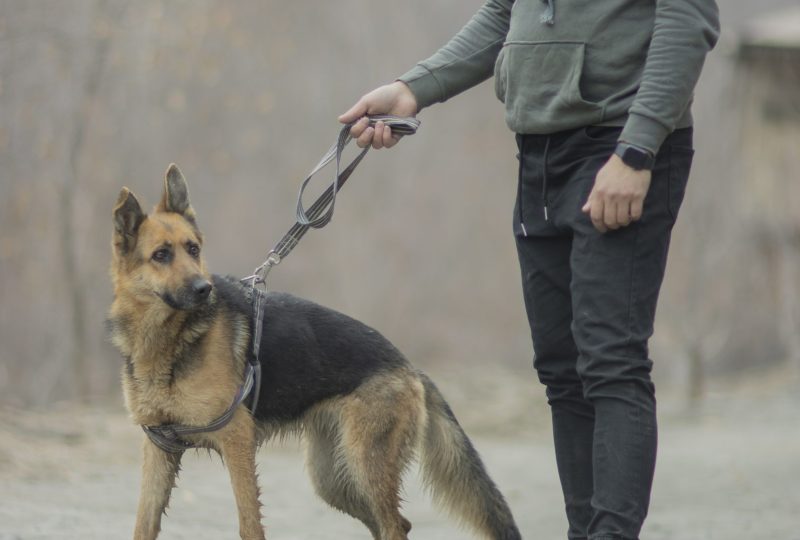
How to Stop a German Shepherd From Pulling on the Leash
A calm, repeatable loose-leash walking plan for German Shepherds — no prong collars, no yanking, no shutting the…