Skinny Dog Breeds: Naturally Lean Dogs and When Thin Means Unwell
The sighthounds and other breeds built to be lean, how to assess body condition properly on any dog, the medical causes of weight loss including EPI in German Shepherds, and how to put weight on safely.

Short answer: some dogs are built thin — and some are thin because something is wrong
Sighthounds like Greyhounds, Whippets and Salukis are meant to look lean: visible ribs and a deep tuck are normal and healthy for them. What is not normal is a dog of any breed losing condition. If you can see the spine, hip bones and ribs sharply on a German Shepherd, or your dog is eating well and still dropping weight, that is a vet visit — not a bigger dinner.
Someone stops you in the park to say your dog looks thin. Someone else, the same week, tells you they look great. You go home, run your hands along their ribs and genuinely cannot decide who is right — because nobody ever explains what a healthy dog is actually supposed to feel like.
Two things are going on, and they get muddled constantly. Some breeds are built lean — a Greyhound at a perfectly healthy weight looks emaciated to someone used to Labradors. And separately, any dog can become too thin, which is a medical question rather than an aesthetic one.
This guide covers the naturally lean breeds and what living with them is like, how to assess body condition properly on any dog, the medical causes of weight loss worth knowing about — including one that German Shepherds are particularly prone to — and how to put weight on a thin dog safely.
This guide can help you assess body condition and ask better questions. It cannot diagnose anything. Unexplained weight loss in a dog always deserves a vet appointment — particularly if your dog is eating normally, or hungrily, and still losing condition.
Why Some Breeds Are Built Lean
The slim breeds are almost all sighthounds — dogs bred to chase down fast prey by sight over open ground. Everything about their shape follows from that job.
A sprinting dog needs a deep chest for lung and heart capacity, a narrow waist and flexible spine for the galloping stride, long legs, fine bone and almost no spare weight to carry. Body fat is dead weight to an animal built for acceleration, so sighthounds carry very little of it — typically a much lower body fat percentage than other breeds of similar size.
Which means the visual rules are genuinely different. On a Greyhound, seeing the last two or three ribs, the hip bones and a dramatic waist is correct. Applying that same picture to a German Shepherd would mean a dog who had lost significant condition.
Judge by breed and by feel, not by comparison with the dogs you happen to know. The universal test that works on every breed: you should be able to feel ribs easily with a flat hand, and see a waist from above.
The Naturally Slim Breeds
| Breed | Built for | What they are like to live with |
|---|---|---|
| Greyhound | Short, explosive sprints | Famously calm indoors — the “45 mph couch potato”. Short coat, minimal grooming, feels the cold. Excellent rescue availability |
| Whippet | The same in miniature | Gentle, quiet, affectionate and velcro-like. Needs secure fencing and a coat in winter |
| Italian Greyhound | Companion sighthound | Tiny, fragile-boned, deeply attached to their person. Leg fractures are a real risk from jumping off furniture |
| Saluki | Endurance hunting in desert heat | Ancient breed, independent, aloof with strangers, phenomenal stamina. Recall is a genuine project |
| Borzoi | Coursing wolves across open steppe | Huge but light, elegant and quiet indoors. Needs space to stretch out and a very secure garden |
| Sloughi & Azawakh | North and West African hunting | Rare, extremely lean, reserved with strangers, deeply bonded to their household |
| Ibizan Hound | Hunting rabbit over rough ground | Athletic and comic, superb jumpers — fences need to be higher than you think |
| Pharaoh Hound | Sight and scent hunting | Bright, sensitive, prone to “blushing” pink ears and nose when happy |
Two honourable mentions that are lean without being sighthounds: the Vizsla and the Weimaraner, both athletic gundogs who look slim and need considerably more exercise and company than a Greyhound does.
What Living With a Sighthound Is Like
Worth covering, because people assume a fast dog is a demanding one, and it is usually the opposite.
- Very low exercise needs — sprint, then sleep for hours
- Quiet indoors; many rarely bark
- Short coats, minimal grooming, little shedding smell
- Often superb in flats
- Gentle and undemanding with people
- Rescue Greyhounds arrive already crate and lead trained
- Strong prey drive — off-lead needs real thought
- Recall is harder than in most breeds
- Thin skin tears easily; thin coats feel the cold
- Very little padding — they need soft bedding
- Some anaesthetic and medication sensitivities
- People will constantly tell you they look underfed
If you are comparing a sighthound with a German Shepherd for your household, the honest summary is that a Greyhound needs far less exercise and far less mental work — and offers far less of the partnership that draws people to a working breed. Different jobs entirely. Our breed introduction covers the other side of that trade.
How to Check Body Condition Properly
Vets use a body condition score, usually out of nine. You do not need the chart — you need three checks, done with your hands, once a fortnight.
Flat hands along the ribcage, light pressure. Ribs should feel like the back of your hand — findable easily, with a thin covering. If you have to press to find them, that is too much covering. If they feel like your knuckles, too little.
Stand over your dog. There should be a clear waist behind the ribcage. A straight line from ribs to hips is overweight; a dramatic hourglass with visible hip bones is underweight in most breeds.
The belly should tuck up from the ribcage towards the back legs. Parallel to the floor is too heavy; a very deep tuck with prominent hip bones is too thin (except in sighthounds, where a deep tuck is normal).
Run a hand along the back. Vertebrae and hip bones should be felt with light pressure, not seen as sharp ridges. Sharp, prominent bones you can see across a room usually mean lost muscle as well as fat.
Same spot, same angle, from above and from the side. Gradual change is nearly invisible day to day and completely obvious in photographs three months apart. It is also extremely useful to show your vet, who has no idea what your dog looked like in June.
When Thin Is a Problem
Regardless of breed, these are the signs that a dog is genuinely underweight rather than naturally lean.
- Losing weight over time — the trend matters far more than any single snapshot.
- Visible spine and hip bones as sharp ridges, with obvious muscle loss over the hindquarters and skull.
- Eating well but still thin — this combination in particular points at absorption or metabolism.
- Poor coat — dull, dry, thinning, or heavy scurf.
- Low energy or reduced stamina compared with a few months ago.
- Digestive signs — chronic loose stools, very large volumes of stool, vomiting, or ravenous hunger.
Any of those means a vet appointment, and the sooner the better. Weight loss with a good appetite is a particularly important pattern to report, because it narrows the list of likely causes considerably.
Medical Causes of Weight Loss
| Cause | Typical picture |
|---|---|
| Parasites | Worms are the classic cause in puppies — pot belly, poor coat, weight loss despite eating |
| Dental disease | Eating less, chewing on one side, dropping food. Extremely common and often missed |
| Not enough food | Growing puppy, working dog, cold weather, or a bag guideline followed without adjusting |
| Digestive disease | Chronic diarrhoea, malabsorption, inflammatory bowel disease |
| EPI | Ravenous appetite, huge pale greasy stools, weight loss — see the next section |
| Kidney or liver disease | Often with increased drinking, vomiting or lethargy |
| Diabetes | Drinking and urinating more, eating well, losing weight |
| Cancer | Gradual loss of condition, sometimes with no other early signs |
| Pain or stress | Reduced appetite; also common after a house move or bereavement |
The instinct with a thin dog is to increase the food, and if the problem is absorption, parasites, dental pain or disease, extra food does nothing except delay the diagnosis. Get the cause investigated first, then feed to the plan your vet gives you.
EPI: The German Shepherd One
This deserves its own section because German Shepherds are over-represented for it, and because it is one of the most treatable causes of a permanently thin dog once it is identified.
Exocrine pancreatic insufficiency means the pancreas is not producing enough of the enzymes needed to digest food. The dog eats normally — often ravenously — and cannot absorb what they eat. The classic picture is a young adult German Shepherd who is hungry all the time, losing weight, and producing large volumes of pale, soft, greasy, foul-smelling stool. Some also eat things they should not out of sheer hunger.
It is diagnosed with a specific blood test (a TLI test), and it is managed with enzyme replacement added to every meal, sometimes alongside vitamin B12 supplementation and a specific diet. Dogs who are diagnosed and treated often regain condition impressively and live entirely normal lives.
The reason it matters here: owners frequently spend months cycling through expensive foods for a “sensitive stomach” while the actual problem goes undiagnosed. If that description fits your dog, ask your vet specifically about testing for EPI.
Putting Weight On Safely
Once your vet has established the cause and given you a plan, the practical side is straightforward — and slower than most owners expect.
Treat the cause first
Worming, dental treatment, enzyme replacement, medication — whatever your vet has identified. Nothing else works properly until this is handled.
Why it works: a dog who cannot absorb food will not gain weight regardless of how much goes in the bowl.
Increase gradually, not dramatically
Add roughly 10% more food and hold it for a week or two. Sudden large increases cause diarrhoea, which makes a thin dog thinner.
Why it works: the gut needs time to adapt, particularly if it has been struggling.
Split into more meals
Three or four smaller meals rather than two larger ones. Easier to digest and gentler on a compromised system.
Why it works: smaller volumes absorb better, and it reduces the risk associated with large single meals in deep-chested breeds.
Use a more calorie-dense food if advised
Rather than simply serving more of a low-density food. Your vet may recommend a specific recovery or performance diet.
Why it works: it gets more nutrition into a dog who can only comfortably eat so much volume.
Keep exercising — build muscle, not just fat
Gentle, consistent activity as your vet allows. Weight gain that is all fat and no muscle is not the goal.
Why it works: muscle is what makes a dog look and function well, and it is what a thin dog has usually lost most of.
Weigh weekly and expect gradual change — a sensible target is often around 1–2% of body weight per week, but your vet will set the right pace for your dog. Our feeding guide covers portions and body condition in more detail.
What a German Shepherd Should Look Like
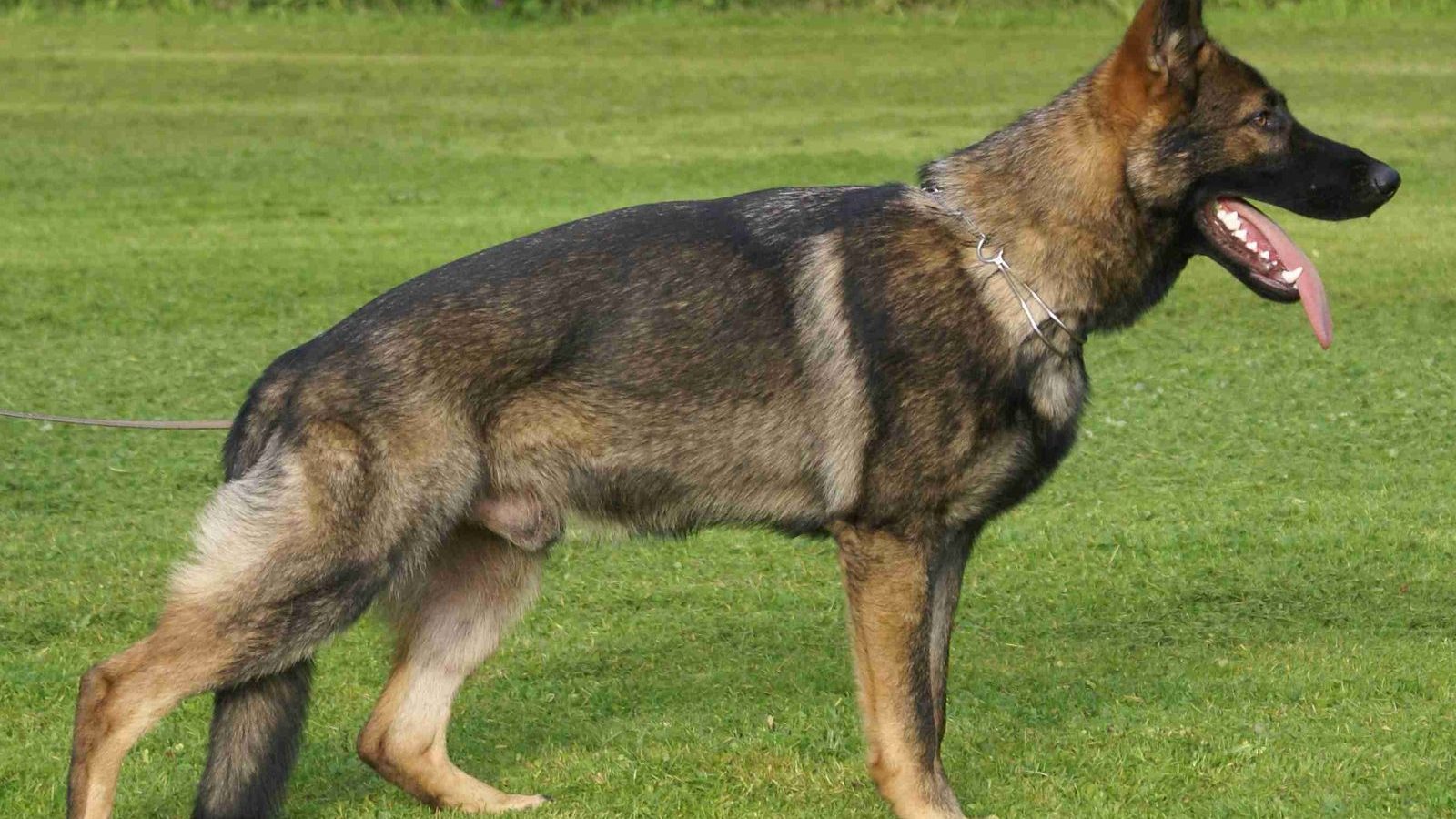
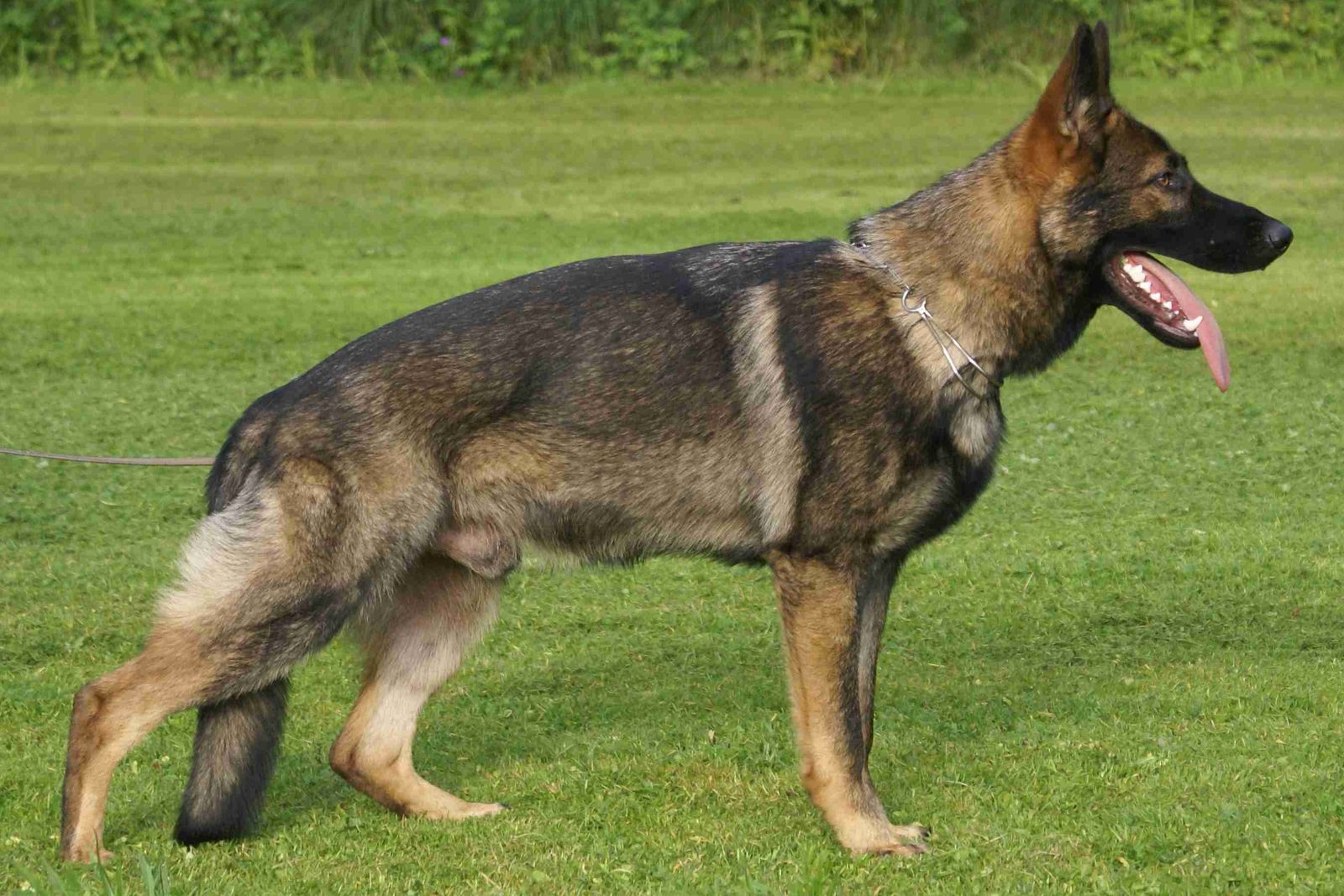
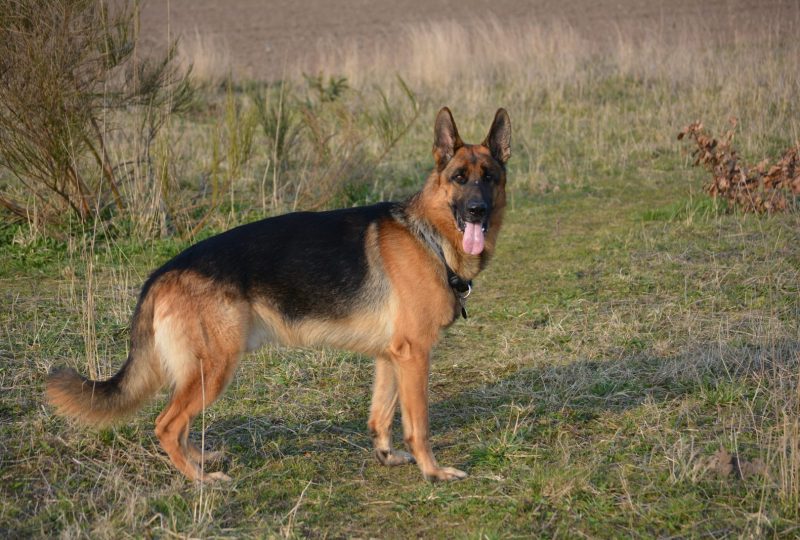
Since this is the breed most readers here own: a German Shepherd in correct condition is athletic and clearly waisted, with a covering of muscle over the ribs and hips. You should feel ribs easily and see the last one or two when they move, see a defined waist from above, and see a belly that tucks up from the side.
What you should not see on a healthy adult Shepherd is a sharply visible spine, prominent hip bones, hollows above the eyes, or wasting over the shoulders and hindquarters. Those suggest lost muscle, and muscle loss is a different problem from being slightly light.
One important nuance: adolescent German Shepherds go through a genuinely lanky stage, roughly between six and fourteen months, where they look leggy and narrow while the frame grows faster than the muscle fills it. That is normal, and the answer is not to fatten them up — an overweight adolescent large-breed dog is loading growing joints. Feed to condition, keep them lean, and let the muscle arrive.
Kit That Helps
We recommend product types and the features that matter rather than sponsored placements, and we link to live Amazon results instead of quoting prices that go stale. As an Amazon Associate we may earn from qualifying purchases — at no extra cost to you.
Digital scales — kitchen and bathroom
Two cheap purchases that turn a worry into a trend line. Kitchen scales let you feed a measured portion rather than a guessed scoop; bathroom scales let you weigh yourself, then yourself holding the dog, and track the difference month by month.
- Turns “he looks a bit thin” into an actual number over time
- Lets you feed accurately rather than by eye
- Gives your vet a trend, which is far more useful than one reading
- Most vet practices also let you use their scales free — use both
Good to know: weigh at the same time of day, before a meal, and write it down. A single weight tells you very little; six monthly weights tell you almost everything.
| Item | Why it helps | Find it |
|---|---|---|
| Slow feeder bowl | For dogs who gulp — better digestion, less wasted food | See options → |
| Airtight food container | Keeps a calorie-dense food fresh and palatable | See options → |
| Orthopaedic bed | Thin dogs have little natural padding over bony points | See options → |
| Dog coat | Lean, short-coated dogs genuinely feel the cold | See options → |
| Body condition chart | A printable score chart on the fridge beats guessing | See options → |
7 Mistakes (and the Fix for Each)
❌ 1. Judging a sighthound by Labrador standards
A Greyhound at a healthy weight looks alarming to someone used to rounder breeds — and gets fattened up unnecessarily.
✅ Fix: learn the correct condition for the breed in front of you, and ask a vet if unsure.❌ 2. Feeding more instead of investigating
If the problem is parasites, teeth or absorption, extra food changes nothing except the timeline.
✅ Fix: vet first for any unexplained weight loss, especially with a good appetite.❌ 3. Missing EPI in a German Shepherd
Months of “sensitive stomach” foods while a treatable, testable condition goes undiagnosed.
✅ Fix: ravenous appetite + weight loss + large pale greasy stools = ask specifically about a TLI test.❌ 4. Fattening a lanky adolescent
A leggy eight-month-old Shepherd is normal. Extra weight on growing joints is not.
✅ Fix: feed to condition, keep them lean, and let muscle fill the frame over the next year.❌ 5. Judging by eye alone
Coat length hides a great deal in both directions — a fluffy dog can be thin, a smooth one can look bonier than they are.
✅ Fix: assess with your hands, not your eyes, and photograph monthly.❌ 6. Increasing food too fast
A sudden large increase causes diarrhoea, which makes a thin dog thinner and everyone more anxious.
✅ Fix: about 10% at a time, held for a week or two, split across more meals.❌ 7. Ignoring gradual loss in an older dog
Slow weight loss in a senior gets attributed to age, when it is one of the earliest signs of several treatable conditions.
✅ Fix: monthly weigh-ins from about seven, and any unexplained loss gets investigated.A healthy dog of any breed is one you can run your hands over and feel ribs without pressing, and see a waist from above. Everything else is what that particular breed happens to look like.
Frequently Asked Questions
What dog breeds are naturally skinny?
Mostly sighthounds — Greyhounds, Whippets, Italian Greyhounds, Salukis, Borzoi, Sloughi, Azawakh, Ibizan and Pharaoh Hounds. They are built for speed, carry very little body fat, and visible ribs and hip bones are normal and healthy for them.
Is my German Shepherd too thin?
If you can feel ribs easily and see a waist, they are probably about right. If the spine and hip bones stand out sharply, there is visible muscle wasting, or they have been losing weight, that is a vet appointment — especially if their appetite is normal or increased.
Why is my dog thin even though he eats a lot?
Eating well while losing weight points at absorption, metabolism or parasites rather than portion size. In German Shepherds, EPI is a well-recognised cause and is diagnosed with a specific blood test. Other possibilities include worms, digestive disease, diabetes and thyroid problems. This combination always warrants investigation.
How do I safely help my dog gain weight?
Have the cause diagnosed first, then increase food by around 10% at a time, split into more meals, and consider a more calorie-dense diet if your vet suggests one. Keep gentle exercise going so the gain includes muscle, and weigh weekly to track progress.
Should I be able to see my dog’s ribs?
You should be able to feel them easily in any breed. Seeing the last one or two during movement is normal in lean, athletic dogs. Clearly seeing several ribs at rest is normal in sighthounds and a warning sign in most other breeds.
Are skinny breeds healthier than heavier ones?
Lean body condition is associated with better long-term joint health and longevity in dogs generally — but that is about condition, not breed. Sighthounds have their own health considerations, including sensitivity to some anaesthetics and medications, thin skin that tears easily, and a need for warmth and soft bedding.
✅ Your Body Condition Checklist
- Ribs felt easily with a flat hand — the universal test
- Waist visible from above; belly tucks up from the side
- Spine and hips felt, not seen as sharp ridges (sighthounds excepted)
- Body condition checked every fortnight
- Photographed monthly, same spot and angle
- Weighed monthly — at home or at the vet
- Breed standards applied to the breed in front of you
- Adolescent lankiness accepted, not fed away
- Any unexplained weight loss → vet appointment
- Ravenous appetite + weight loss + greasy stools → ask about EPI
- Cause treated before increasing food
- Weight gain built gradually, with exercise for muscle
The Bottom Line
Some dogs are meant to be thin. A Greyhound at a perfect weight will always attract comments from people used to rounder breeds, and those people are wrong. Learn what correct looks like for the dog in front of you and stop comparing.
But a dog who is becoming thin is telling you something, and the message is worth reading properly. Feel the ribs, watch the trend, and if the numbers are going the wrong way — particularly with a healthy appetite — book the appointment rather than the bigger bag of food.
- German Shepherd feeding guide — portions and body condition by life stage
- Healthcare for your German Shepherd — the weekly home check
- The most popular dog breeds — how the lean breeds compare
- Free feeding cost calculator — work out portions and monthly cost
Recommended German Shepherd gear for this guide
Waterproof car seat cover (hammock)
Best for: Protecting back seats on trips
- Waterproof
- Side flaps
Affiliate link — we may earn a commission, at no cost to you.
Heavy-duty puzzle feeder
Best for: Mental stimulation and slow feeding
- Builds focus
- Slows fast eaters
Affiliate link — we may earn a commission, at no cost to you.
Padded training leash 6ft
Best for: Daily walking and city control
- Padded handle
- Strong hardware
Affiliate link — we may earn a commission, at no cost to you.

Keep reading
More in Lifestyle & Travel →
The Most Popular Dog Breeds and Where the German Shepherd Ranks
Which breeds top the rankings and why, where the German Shepherd sits after a century in the top…
The History of the German Shepherd Dog: From Herding Fields to Family Homes
How the breed was created in 1899 by Max von Stephanitz, its move into police work, the world…
The Most Adorable Dog Breeds (and Where German Shepherds Fit)
Why we find certain dogs irresistible, fifteen genuinely adorable breeds with the honest version of living with each,…